For millions of urban Indians, the biggest barrier to buying an electric car is not price or range - it is parking. If you live in an apartment, your car sleeps in a basement or a stilt parking slot that you do not fully control, and installing a charger there means talking to your Resident Welfare Association (RWA) or society management committee.
What the rules say
New buildings: the 20% provision
In February 2019, the Ministry of Housing and Urban Affairs amended the Model Building Bye-Laws 2016 to add provisions for EV charging infrastructure. The amendment uses a planning assumption that charging should be provided for 20% of the vehicle-holding or parking capacity in new buildings, along with additional electrical load to support it. These are model bye-laws: they apply once a state or urban local body adopts them in its own building rules, and the exact percentage can vary between states.
Existing buildings: separate connections
The Ministry of Power's 2024 guidelines on EV charging infrastructure explicitly allow group housing societies, RWAs and individual residence owners to apply for a separate metered connection for EV charging at the applicable EV tariff, and allow DISCOMs to provide sub-metering behind an existing HT connection. This gives societies a clear, regulator-backed path to transparent billing.
Maharashtra
Maharashtra’s EV Policy 2025 promotes EV-ready parking, including shared charging in existing housing societies. A 2022 directive from the state Cooperation Department reportedly requires societies to respond to a member’s request for an EV charger NOC within a set period, provided the member follows the applicable electrical safety advisory.
Tamil Nadu
In Tamil Nadu, residential supply comes from TNPDCL. Under the Ministry of Power’s 2024 guidelines, residents and associations can request a separate connection for EV charging; confirm the current options and tariff with TNPDCL before planning a shared installation.
Tip: Rules evolve quickly. Before your RWA meeting, check your state's current EV policy and your DISCOM's EV connection process so your proposal reflects the latest provisions.
Common RWA concerns - and how to answer them
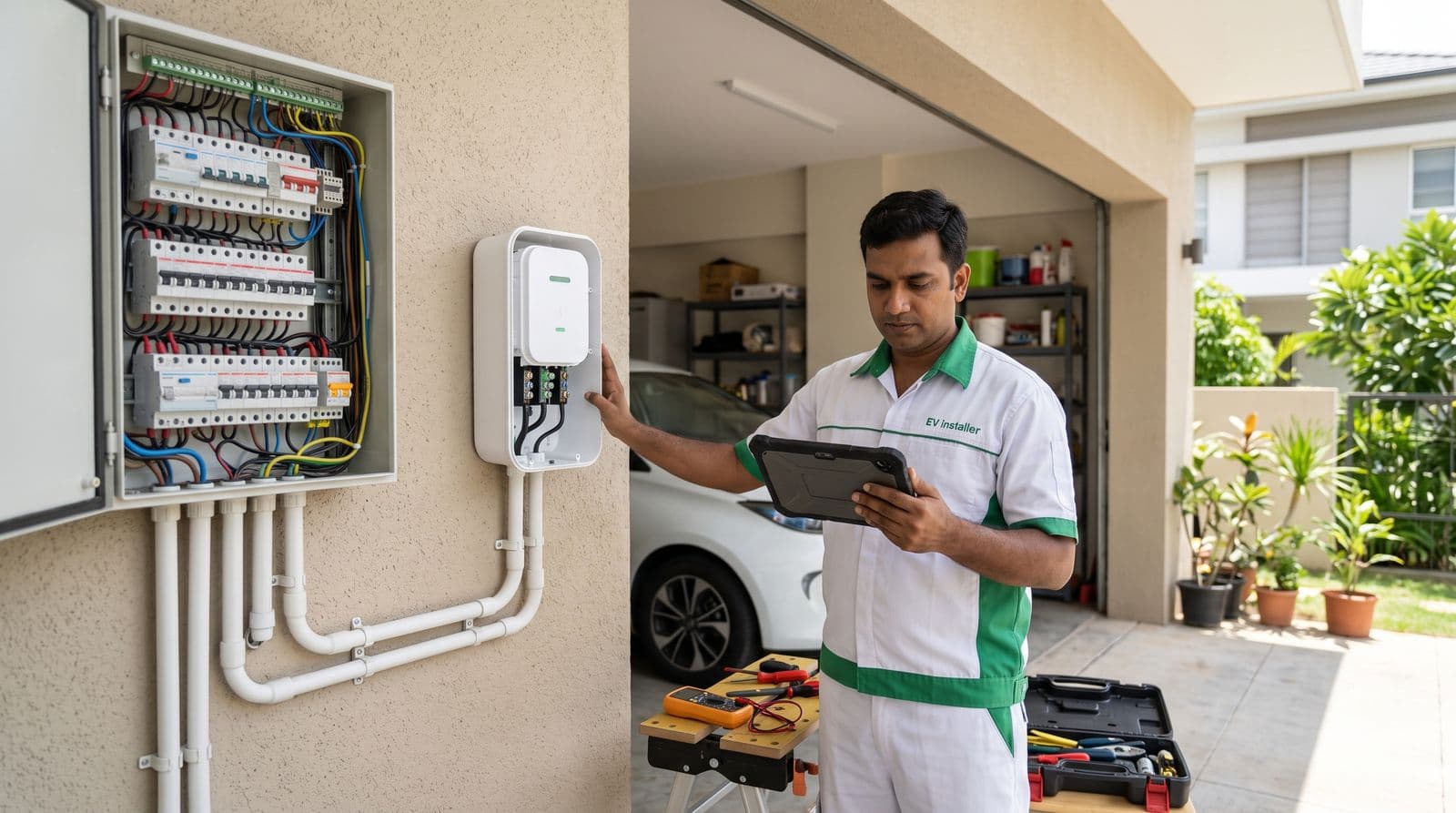
- Fire safety: propose certified chargers, a professional installation, proper protection devices and fire safety signage. Chargers should be installed by licensed electricians following CEA safety regulations.
- Who pays for electricity: a separate EV meter or individual sub-meter means each user pays for their own consumption.
- Load on the building: a load assessment shows whether the existing transformer and connection can handle the chargers, and smart load management can share capacity across several chargers.
- Use of common areas: a written agreement can define cable routes, maintenance responsibilities and who bears the cost of any repairs.
- Fairness to non-EV owners: a shared or bookable charger with per-kWh billing avoids any cross-subsidy.
Three models that work
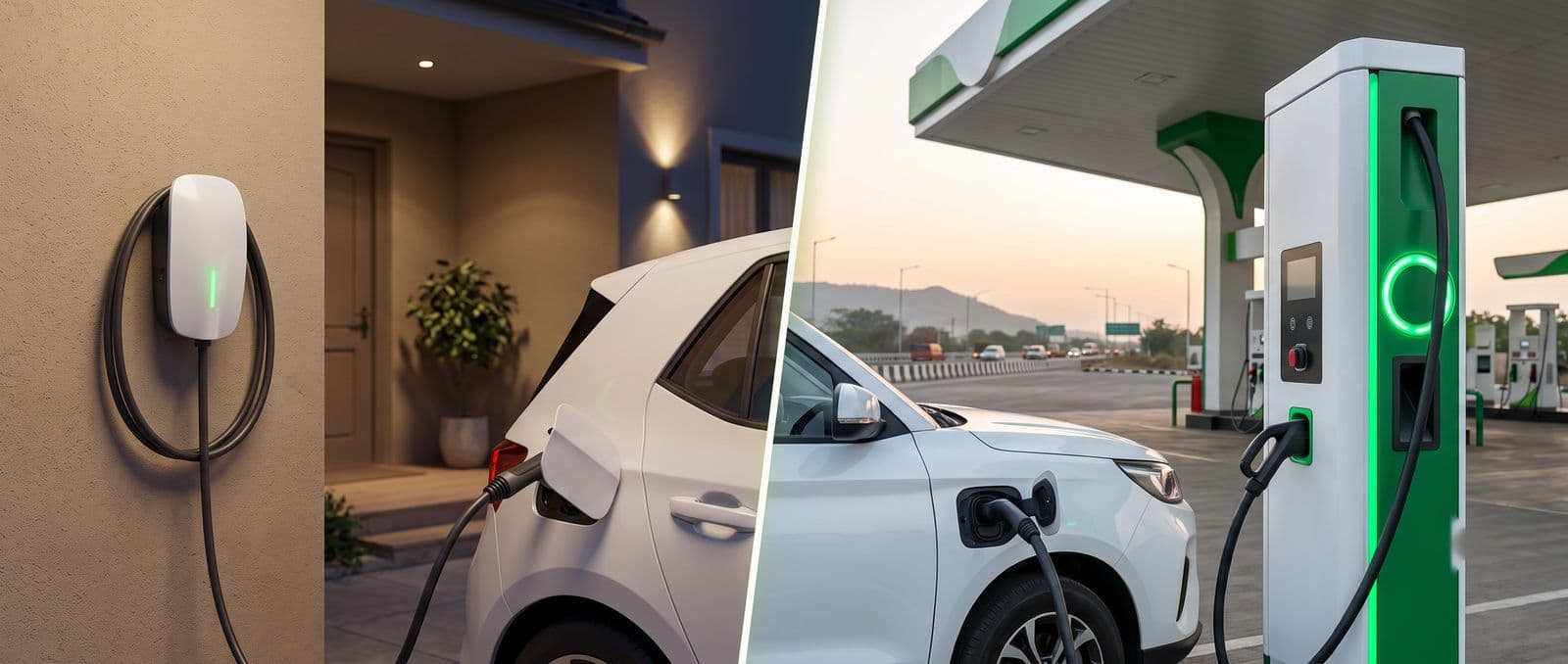
- Individual charger at an allotted slot: the resident pays for the charger and installation, powered from their own meter or a sub-meter. Simplest when parking is allotted.
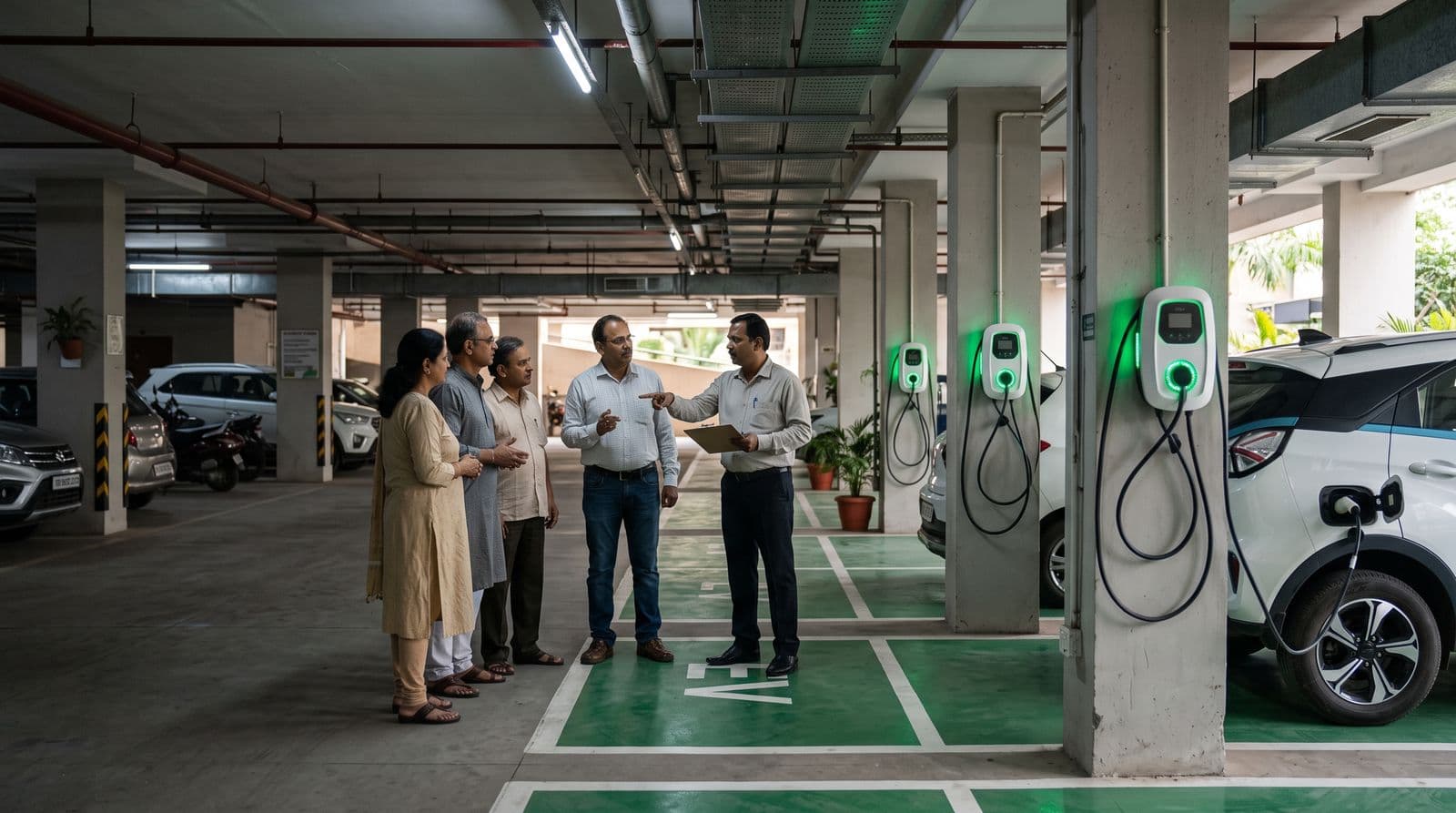
- Shared society chargers: the society installs a few chargers in common parking on a separate EV connection, and residents pay per kWh through an app with QR or RFID authentication.
- Operator-managed hub: a charge point operator installs and maintains the chargers, typically under an agreement with the society, and bills users directly.
Amphive’s apartment and community charging solution covers site assessment, shared or individual charger options and coordination with your association. Residents with their own parking slots can also book a home charger installation.
A simple proposal template
When you approach your RWA, a one-page proposal goes a long way. Include the charger model and certifications, the installation plan and cable route, how electricity will be metered and paid for, who maintains the equipment, insurance or liability arrangements, and a commitment to remove the equipment and restore the area if required. Offering to share the charger with neighbours on a pay-per-use basis often turns sceptics into supporters.
Charging etiquette in shared parking
- Move your car once charging is complete so others can use the charger.
- Do not unplug someone else's car unless the society's rules allow it.
- Coil cables neatly and report any damage immediately.
- Use booking features where available to avoid queues at peak times.
The best society charging setups are boring: metered, booked through an app, and nobody argues about the electricity bill.
With a clear proposal, transparent billing and professional installation, most RWA concerns can be resolved. As more residents switch to EVs, societies that plan early will find it far easier than those that react later.
Frequently asked questions
Societies manage common areas and may set reasonable conditions on safety, billing and installation. A proposal that addresses those concerns, using a separate meter or sub-meter and a certified installer, is much more likely to be approved.
The 2019 amendment to the Model Building Bye-Laws is aimed mainly at new buildings and applies where states or local bodies have adopted it. Existing buildings can still add chargers using separate EV connections or sub-meters.
The usual approach is a separate EV connection with app-based per-kWh billing, so each user pays for exactly what they use.
Sources
- Model Building Bye-Laws amendment for EV charging (IEA policy database)
- MoHUA EV charging infrastructure guidelines (PDF)
- Ministry of Power EV charging guidelines 2024 (Mercom India summary)
- Maharashtra EV Policy 2025 – summary (EVreporter)
- EV chargers in Maharashtra housing societies (Cyril Amarchand Mangaldas blog)
Policies and tariffs change. Information is accurate to the best of our knowledge as of the publication date.