How long does it take to charge an electric car? The honest answer is: it depends on four things - the size of the battery, how empty it is, the power of the charger and how much power the car itself can accept. Once you understand those four variables, you can estimate almost any charging session yourself.
The simple formula
Charging time (hours) is roughly the energy you need (kWh) divided by the effective charging power (kW). If your car needs 30 kWh and it is drawing 7 kW, that is a little over four hours. Real sessions take somewhat longer because of conversion losses, and DC sessions slow down as the battery fills.
Tip: Battery size is measured in kWh (energy). Charger output is measured in kW (power). Divide one by the other for a quick time estimate.
Typical times for popular Indian EVs
The figures below come from manufacturer specifications and reputable motoring publications. Different variants, software updates and testing conditions can change them, so treat them as a guide rather than a guarantee.
Tata Nexon EV (45 kWh)
Published figures suggest about 6.5 hours for 10-100% on a 7.2 kW AC home charger. On a DC fast charger, Tata quotes roughly 40 minutes for 10-80% at a 60 kW-class charger, though some reviewers have recorded longer times on 50 kW units. In practice, expect between 40 and 60 minutes for 10-80% depending on the charger.
Hyundai Creta Electric (51.4 kWh)
Listed at about 4 hours 50 minutes for 10-100% on an 11 kW three-phase AC charger, and about 58 minutes for 10-80% on a 50 kW DC charger. On a 100 kW DC unit, the quoted 10-80% time drops to about 39 minutes.
MG Windsor EV (38 kWh)
According to Autocar India, the 38 kWh Windsor takes about 6.5 hours to charge fully on the optional 7.4 kW AC charger, while the standard 3.3 kW charger is considerably slower. On a 45 kW-class DC charger, it can go from 0-80% in roughly 55 minutes.
Mahindra BE 6 (79 kWh pack)
Mahindra quotes around 20 minutes for 20-80% on a DC fast charger capable of roughly 175 kW. Most public chargers in India today are slower than that, so on a 60 kW unit expect the session to take noticeably longer. On AC, a full charge of the large 79 kWh pack takes many hours, which is why an 11 kW home charger is a popular choice for owners with three-phase supply.
What slows charging down
- Battery temperature: a very hot or very cold battery accepts less power. Many cars precondition the battery when navigating to a fast charger.
- State of charge: DC charging is fastest in the middle of the battery and tapers sharply above about 80%.
- Shared power: some public chargers split output between two guns when two cars are plugged in.
- Supply limits: a home circuit or society transformer may limit what an AC charger can deliver.
- Onboard charger limits: on AC, the car's onboard charger caps speed regardless of the wallbox rating.
Charge to 80% on the road, 100% when you need it
Because DC charging slows dramatically near the top, stopping at around 80% and moving on is usually quicker than waiting for 100%. At home, many manufacturers recommend setting a daily limit of around 80-90% for routine use and charging to 100% before a long trip. Check your owner's manual, since recommendations differ between battery chemistries; some LFP-battery cars ask you to charge to 100% periodically to keep the range estimate accurate.
Getting home charging right
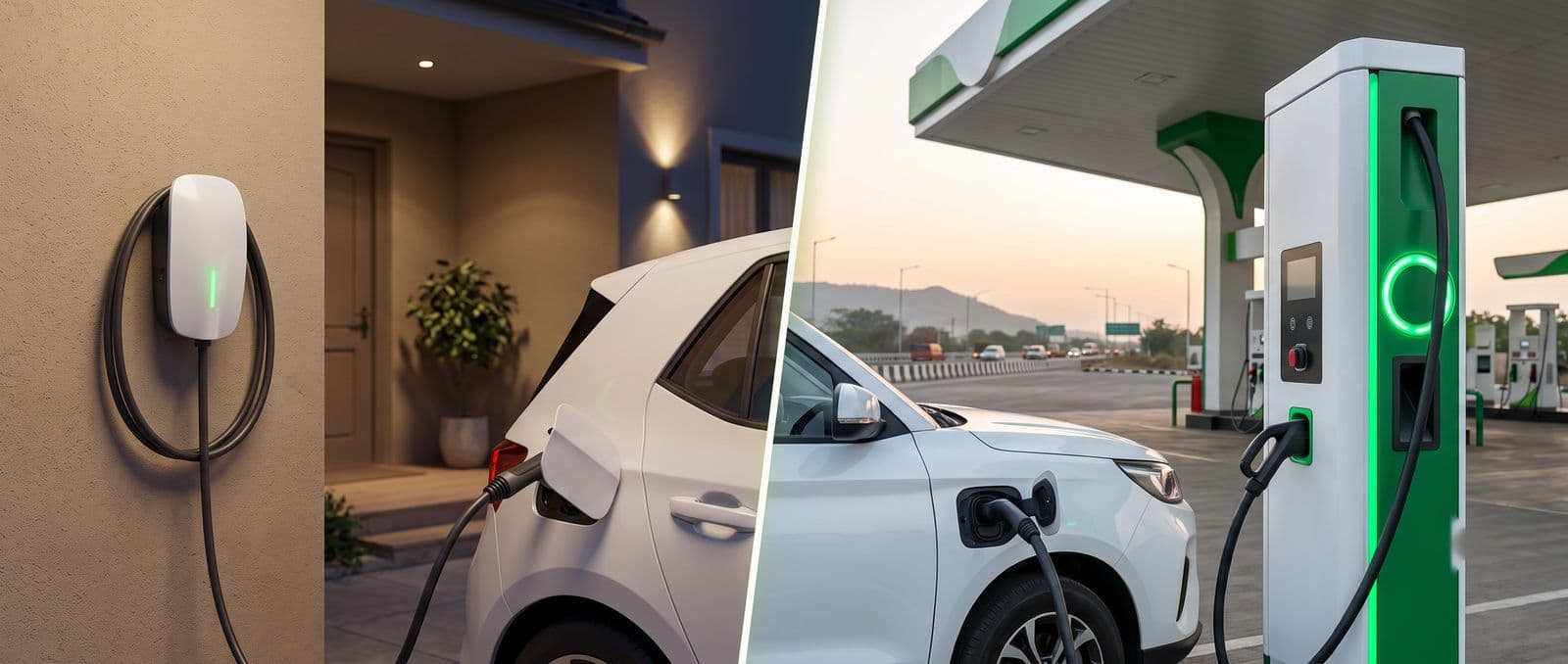
If you charge overnight at home, the most useful step is matching the charger to your car’s onboard charger, so you are not paying for power your car cannot use. Amphive’s installation assessment checks your car, your connection and your sanctioned load before recommending a setup.
- Find your car's battery size (kWh) and maximum AC and DC charging rates in the owner's manual.
- Note the charger power you have access to at home and on your usual routes.
- Use the formula: energy needed divided by the lower of charger power and car acceptance.
- Add 10-20% for losses and tapering, more for DC sessions that go past 80%.
Most EV owners rarely wait for their car to charge - it charges while they sleep, work or eat.
Once charging becomes part of your routine, the question changes from how long it takes to where you will be parked anyway. That shift is the real convenience of owning an EV.
Frequently asked questions
Charging is fastest in the middle of the battery and slows significantly above about 80% to protect the cells. The 10-80% figure reflects the most useful portion of a fast-charging stop.
Many EVs come with a portable charger that works on a 15 A socket at around 3 kW, but the circuit must be properly rated and earthed. A dedicated wallbox is faster and safer for daily use.
It can. In high temperatures the battery management system may reduce charging power to keep the battery cool, particularly during DC fast charging.
Sources
- Tata Nexon EV specifications (Autocar India)
- Hyundai Creta Electric specifications (CarDekho)
- MG Windsor EV range and charging (Autocar India)
- Mahindra BE 6 (Wikipedia)
Policies and tariffs change. Information is accurate to the best of our knowledge as of the publication date.